
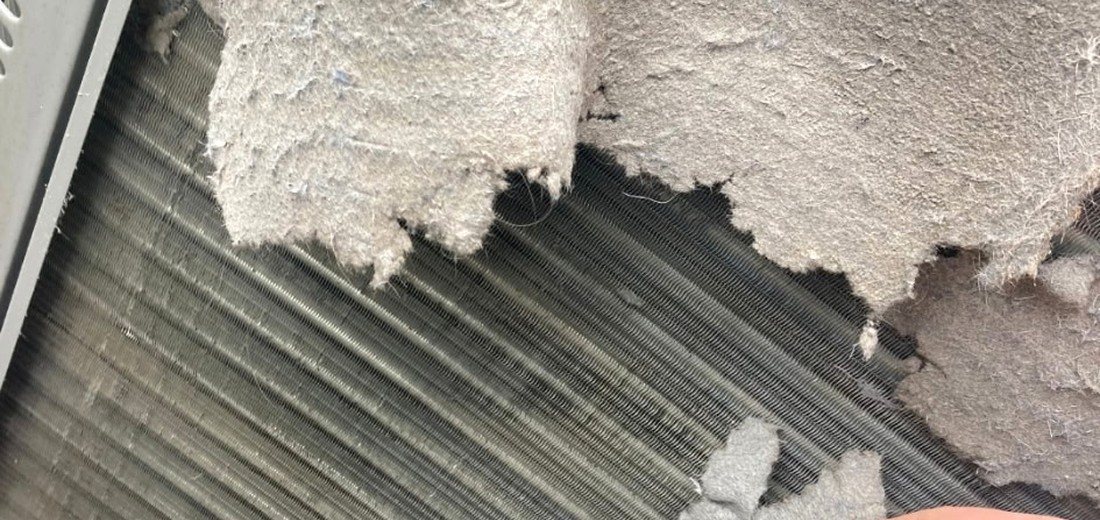
Start with the easy checks.
Before assuming something major has failed, check the things a homeowner can safely see. Make sure the return filter is not heavily loaded, supply registers are open, furniture or rugs are not blocking returns, and the thermostat is set normally.
If airflow improves after replacing a dirty filter, that restriction may have been part of the problem. If it does not improve—or the filter gets dirty unusually fast—the system deserves a closer look.
Where airflow can be restricted.
An HVAC system depends on a clear path for air to return to the equipment, move across the indoor components and travel back through the supply ducts. Restrictions or performance problems anywhere along that path can change what you feel at the vents.
- Dirty or overly restrictive filters: A loaded filter can reduce airflow through the equipment.
- Indoor coil buildup: Dirt on the evaporator coil can interfere with heat transfer and airflow.
- Blower buildup or blower problems: The blower has to move the correct amount of air for the system to perform properly.
- Duct restrictions, damage or leakage: Problems in the duct system can reduce delivered airflow or create large room-to-room differences.
- Blocked returns or supply registers: Closed or obstructed openings can change system airflow and comfort.
- Equipment or control problems: Some airflow complaints require electrical, motor, refrigerant or system-level diagnosis rather than cleaning alone.
Why airflow matters in Louisiana.
Cooling is only part of summer comfort. Air conditioners also remove moisture while they operate. When airflow or system performance is off, homeowners may notice rooms that never quite cool, longer run times, uneven temperatures or a house that feels sticky even when the thermostat looks reasonable.
That does not mean every humidity complaint is caused by airflow. Equipment sizing, duct conditions, infiltration and other factors can matter too. The useful question is not “what single part should I replace?” but “what is the system actually doing?”
Signs it is time for a professional diagnosis.
- Airflow remains weak after replacing a dirty filter.
- One part of the house has much less airflow than the rest.
- The AC runs for long periods without keeping up.
- The indoor coil or refrigerant line is icing.
- You see water near the indoor equipment or drain system.
- The system sounds different or the blower seems inconsistent.
- Humidity or comfort has changed noticeably.
BLU can evaluate the system, measure what is happening and explain the next step without making you diagnose HVAC equipment yourself.
COMMON QUESTIONS
Weak airflow FAQs
Why is the airflow from my AC vents weak?
Weak airflow can be related to a dirty filter, buildup on the indoor coil or blower, duct restrictions or leaks, closed or blocked vents, or an equipment problem.
Can a dirty air filter reduce AC airflow?
Yes. A heavily loaded filter can restrict the amount of air moving through the system.
Can weak airflow make a Louisiana home feel more humid?
Airflow and moisture control are connected. If the system is not moving and conditioning air correctly, comfort and humidity control can suffer.
When should I call an HVAC company for weak airflow?
Call for service when airflow stays weak after checking the filter and open vents, when some rooms have very different airflow, when the system freezes, when you see water around the equipment, or when cooling performance has noticeably changed.